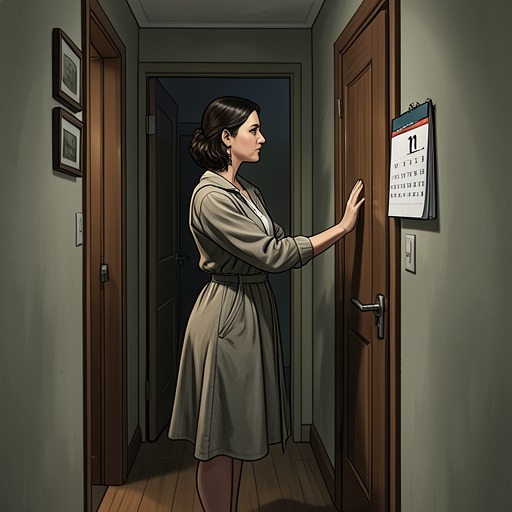
A shark-like marriage sustained by constant moving
Anxious PeopleA shark-like marriage sustained by constant moving is the account Anna-Lena gives Jack for the pattern that has shaped her life with Roger: they buy apartments, renovate them, and sell them, then move on to the next project. The metaphor makes their activity sound like a condition of survival, but Anna-Lena’s later confession exposes its cost. The movement has given the couple a way to keep going together while postponing the settled home she longs for.
The marriage as a moving system
Anna-Lena explains that Roger is drawn to documentaries and has a particular interest in sharks. She recounts the example of a kind of shark that, as she understands it, dies if it stops moving because it cannot absorb oxygen while still. Their marriage, she says, has become like that: they keep in motion so that it can breathe. In this account, movement is not simply a shared pastime. It is the activity around which the couple has organized their life and the means by which they avoid standing still together.
The explanation also gives a marital pattern a practical form. The couple buy, renovate, and sell apartments in a repeating sequence. Each new property supplies a project and a reason to continue. Anna-Lena says she once suggested golf as an alternative, but Roger did not like it. His preference for documentaries and their shared involvement in property projects set the terms of how the pair occupy their time; the routine continues because they have made it their common answer to the question of what comes next.
Retirement and the need for a project
When Jack asks about the hostage situation, Anna-Lena turns to her marriage. She says retirement leaves too much time to think, and that people need a project. Her account therefore recasts the couple’s real-estate activity as more than a financial or practical undertaking: it gives structure to otherwise unfilled time. The cycle keeps them moving, but also supplies a shared purpose at a stage of life when the daily framework of work has changed.
Roger’s response to losing bids adds another pressure to this system. Anna-Lena says he becomes very upset when he fails to win, and that she wanted him to win. She connects this desire to her decision to go behind his back and involve No Boundaries Lennart Ltd. in disrupting apartment viewings. Her actions arise inside the couple’s established property routine, but they also reveal how far she has gone to protect Roger from disappointment. The project that appears to belong to both of them has become entangled with her efforts to manage how he feels about it.
The wish hidden inside the movement
Anna-Lena does not initially tell Roger the whole truth about what she wants. Beyond wanting him to win, she has come to want a home and to stop moving. She imagines ordinary alternatives to the couple’s recurring cycle, including occasionally going to the movies rather than watching another documentary. She also fears that the truth of her betrayal would be too much for Roger. Her silence thus protects him, but it also keeps her own desire for a settled life out of their shared account of the marriage.
The contrast is sharpened by her work decorating apartments to make them look like places where someone would want to live. She can create that appearance for other people, yet says she wishes she could be that person herself and settle somewhere again. The homes she prepares for prospective buyers embody a possibility she helps stage but does not experience. The difference between making a property feel like home and having a home becomes a measure of what the couple’s constant movement has withheld from her.
Confession and the metaphor’s limits
Anna-Lena eventually admits to Jack that she should not have acted behind Roger’s back. She says she first told herself it would happen only once, but that the lie became easier each time. She had justified her actions as being for Roger, then recognized that they had also served her own needs. Her confession corrects the simpler story that she was merely trying to make him feel like a winner: she has helped sustain their way of life while privately wanting to leave its constant motion behind.
When Roger asks how many times she acted, Anna-Lena says three, but the narration identifies that answer as a lie. Her later admission that the behavior became easier with repetition makes the discrepancy meaningful without resolving it into a precise count. It shows the same pattern at work in her explanation as in the marriage itself: a manageable version of events gives way, gradually, to what she has been reluctant to say.
Narrative significance
Jack tries to bring Anna-Lena back to the facts of the hostage situation, but she insists that her marriage is the problem. That exchange makes the shark image more than an aside about a retired couple’s habits. The novel places the crisis of the apartment viewing alongside the private conflicts people bring into it, showing that practical questions about properties and disrupted bids cannot be neatly separated from questions of home, companionship, and what a shared life has become.
The metaphor captures both the couple’s ingenuity and their trap. Keeping busy has given Anna-Lena and Roger a continuing project, yet the rule that they must keep moving leaves little room for the stillness she now wants. Her confession does not establish that the marriage has ended or that the couple stops buying and selling. It does, however, change the meaning of their routine: what Anna-Lena once describes as the way their marriage breathes is also the pattern from which she hopes to escape.